
Caravaggio: The Bad Boy of the Baroque
Michelangelo Merisi da Caravaggio occupies a remarkable place in the history of Western art. He was one of the most influential painters of the early Baroque period, an artist whose work transformed the way religious and historical subjects could be represented, and a master of light, shadow, and human emotion. He was also, by all surviving accounts, a deeply difficult man. Caravaggio was frequently involved in fights, carried weapons, faced repeated arrests, and eventually killed a man during a violent confrontation in Rome. He spent much of the final years of his life as a fugitive, moving from city to city while continuing to receive important commissions. His life was so turbulent that, were he living today, his name would probably appear in the news almost as often as it appeared in the art world.
Yet the stories surrounding Caravaggio's personality should not distract us from his extraordinary accomplishments as a painter. His influence was enormous, extending throughout Italy and across Europe and inspiring generations of artists. He transformed religious painting by making biblical figures look like real people rather than distant, idealized characters. He used light and darkness with unprecedented theatrical force, creating scenes that seem to unfold immediately before the viewer. Even modern photographers and filmmakers continue to use visual techniques that Caravaggio helped establish more than four hundred years ago. To understand why he became so important, however, it is necessary to begin with the world in which he was trained and the remarkable changes taking place in European art during his lifetime.
The Early Years
Caravaggio was born Michelangelo Merisi in 1571, probably in the town of Caravaggio near Milan, from which his familiar name was eventually derived. His family was reasonably well connected, but his childhood was marked by tragedy. His father and several other members of his family died during an outbreak of plague when Caravaggio was still young. He was eventually apprenticed to the Milanese painter Simone Peterzano, where he received the basic training necessary for a career as an artist.
Sometime during his twenties, Caravaggio made his way to Rome. The city was one of the great artistic centers of Europe, and it was also a city in which the Catholic Church was investing enormous resources in art and architecture. The Protestant Reformation had challenged Catholic authority across Europe, and the Catholic Church responded in part through what historians now call the Counter-Reformation. Churches were being decorated with paintings, sculptures, and architectural projects intended not only to glorify God but also to communicate religious stories and ideas to ordinary worshippers. This created enormous opportunities for talented painters.
Caravaggio arrived in Rome without the prestige or wealth that some established artists enjoyed. He worked in other painters' workshops and initially produced relatively small paintings, often depicting ordinary people and scenes from everyday life. His work attracted attention because it was unlike much of what was being produced by the academic tradition. Instead of filling his paintings with idealized figures who seemed to belong to an imaginary world, Caravaggio painted people who looked as though they had walked in from the streets of Rome.
This approach was central to his artistic revolution. Caravaggio believed that religious stories could become more powerful, rather than less sacred, if their characters were made physically and emotionally believable. His saints could have dirty feet. His apostles could look like laborers. His biblical figures had wrinkles, rough hands, ordinary clothing, and expressions that suggested genuine human reactions. The effect was startling because the viewer was no longer looking at distant figures from sacred history. Instead, the viewer seemed to be witnessing an event taking place in the real world.
The Calling of Saint Matthew
One of the clearest examples of this approach is The Calling of Saint Matthew, painted around 1599–1600 for the Contarelli Chapel in the church of San Luigi dei Francesi in Rome. The painting depicts the moment when Christ calls Matthew, a tax collector, to become one of his disciples. The story itself was familiar to Christian viewers, but Caravaggio presented it in a way that made it feel startlingly immediate.
Matthew and several other men sit around a table counting money. They are dressed in clothing that would have been familiar to people living in Caravaggio's own time rather than in garments designed to make them appear like characters from ancient history. Christ enters from the right, accompanied by Saint Peter, and points toward Matthew. A powerful beam of light crosses the dark room, illuminating the figures and drawing the viewer's attention toward Christ's gesture and Matthew's startled reaction.
The effect is almost theatrical. Caravaggio understood that the placement of light could direct the viewer's eye just as effectively as a stage director could control an audience's attention. The room is largely swallowed by darkness, but the important faces, hands, and gestures emerge into the light. The painting does not simply tell the viewer that Matthew received a calling. It makes the moment of recognition visible.
This dramatic use of light became one of Caravaggio's defining characteristics. The technique is often described by the Italian term chiaroscuro, referring to the contrast between light and dark, although Caravaggio pushed the principle much further than many earlier painters. His darkness was not merely a background against which figures could be seen. Darkness became an active element in the composition. It concealed information, created suspense, and made the illuminated figures appear almost to emerge from the surrounding blackness.
It is difficult to look at these paintings without thinking of modern cinema. Contemporary filmmakers routinely use darkness, controlled lighting, and selective illumination to create suspense or direct the viewer's attention. Caravaggio did not, of course, have a movie camera or a lighting crew waiting somewhere offstage, but he understood many of the same visual principles. If a modern director were trying to introduce a character with maximum dramatic effect, Caravaggio's lighting would be a very good place to begin.
Bringing the Bible Into the Real World
Caravaggio's realism was not simply a matter of making people look ordinary. It changed the emotional relationship between the viewer and the story being represented. Earlier religious paintings could create a sense of grandeur by placing their subjects within carefully ordered, idealized spaces. Caravaggio instead made the viewer feel physically close to the event. His figures occupy shallow spaces, often very near the picture plane, and their gestures and expressions are unusually direct.
This approach suited the religious goals of the Counter-Reformation remarkably well. The Church wanted religious art that could communicate clearly and emotionally to ordinary people. A painting of a distant saint might inspire admiration, but a painting showing an exhausted, frightened, or physically vulnerable person could create empathy. Caravaggio understood that emotional immediacy could be a powerful form of religious communication.
His Conversion of Saint Paul, for example, depicts Saul falling from his horse after experiencing a divine vision. Rather than filling the painting with a spectacular heavenly apparition, Caravaggio concentrates on the physical experience of the fallen man. The horse occupies a surprisingly large portion of the composition, while Paul lies on the ground in confusion and surrender. The result is strangely intimate. The viewer is not presented with a grand theological explanation but with the physical moment in which a man's entire life has been overturned.
This was typical of Caravaggio. He frequently found the greatest drama in the human response to an event rather than in the event itself. A miracle might be represented through a face, a gesture, or a body falling to the ground. A religious revelation could occur in an ordinary room. A saint might look like a man one could encounter in a Roman marketplace. By bringing sacred stories into recognizable physical circumstances, Caravaggio made them immediate to his audience.
Judith and Holofernes
Caravaggio was equally capable of creating drama when the subject involved violence, and few paintings demonstrate this better than Judith Beheading Holofernes. The painting depicts the biblical heroine Judith killing the Assyrian general Holofernes after gaining access to his camp and waiting until he was vulnerable.
Caravaggio chooses to show the most violent instant of the story. Judith pulls Holofernes's head toward her while driving a sword into his neck. Holofernes twists backward in an attempt to escape, his face registering surprise and terror. Blood spills across the white sheets, while Judith's companion, Abra, assists her. The figures are placed extremely close to the viewer, and the dark background leaves almost nothing to distract from the action.
What makes the painting so effective is the balance between violence and control. The scene is horrifying, but the composition is carefully organized. The white fabric, the women's clothing, the sword, the bodies, and the dramatic illumination all contribute to a single visual event. Caravaggio understood that the viewer did not need to see every detail of the surrounding environment. The human figures themselves were enough.
The painting also demonstrates his remarkable ability to make expressions and gestures carry a narrative. Judith's face is concentrated rather than hysterical. Holofernes is caught in the instant between life and death. Abra's physical participation makes the scene feel like a struggle rather than a symbolic tableau. Everything is happening at once, and the viewer has been placed close enough to feel almost like an unwilling witness.
The Artist Becomes a Problem
While Caravaggio's professional reputation was growing, his personal behavior was becoming increasingly troublesome. He was known to frequent taverns and gambling establishments and had a reputation for carrying weapons and becoming involved in disputes. Records from the period document repeated encounters with the law. He was arrested for various offenses, including carrying weapons illegally and engaging in violent altercations.
It is tempting to romanticize this aspect of his life because of the familiar stereotype of the rebellious artistic genius. The reality is less charming. Caravaggio was not simply an eccentric who refused to conform. His temper and violent behavior had consequences for other people, and eventually those consequences became catastrophic.
In 1606, Caravaggio became involved in a violent confrontation with a man named Ranuccio Tomassoni. The exact circumstances remain a subject of historical debate, but the confrontation resulted in Tomassoni's death. Caravaggio was held responsible and fled Rome, effectively becoming a wanted criminal.
This marked the beginning of a completely different phase of his life. The painter who had been receiving important commissions from churches and wealthy patrons was now moving from place to place in an attempt to avoid arrest. Yet remarkably, his career did not collapse. Patrons continued to seek him out, and he continued to produce important paintings.
If Caravaggio had been the sort of person who could simply stay out of trouble, his biography would probably be much shorter. Unfortunately for his peace of mind—and fortunately for historians—he appears to have been incapable of doing so.
Life as a Fugitive
Caravaggio fled first to Naples, where he continued to work successfully. From there he traveled to Malta, hoping that membership in the Order of Malta might provide him with protection and eventually help him obtain a pardon that would allow him to return to Rome.
For a period, his plan appeared to be working. He was accepted into the Order and received important commissions. But his temper once again caused problems. Caravaggio became involved in a serious altercation, was imprisoned, and eventually escaped.
He then moved through Sicily and returned to Naples, continuing to paint despite the uncertainty surrounding his future. His situation was extraordinary. Few artists have ever maintained such a significant professional reputation while simultaneously living as fugitives from the law.
His paintings from these years often have an unusually dark and somber character. Some are physically violent, while others seem almost haunted by themes of death and mortality. Whether these qualities should be directly connected to Caravaggio's personal circumstances is difficult to determine, but the paintings certainly reveal an artist increasingly interested in human vulnerability.
The Death of the Virgin
One of the paintings that had caused controversy even before Caravaggio became a fugitive was The Death of the Virgin. Painted around 1605–1606, the work depicts the death of the Virgin Mary surrounded by the grieving apostles.
The subject had been represented countless times, but Caravaggio's interpretation was startlingly physical. Mary does not appear as an idealized heavenly figure. Her body lies heavily across the bed, and her feet are visible. Her face is pale and still. The apostles gather around her in grief, their bodies and gestures emphasizing the emotional reality of the moment.
The painting was rejected by its original patron, and one explanation offered at the time was that Caravaggio had portrayed Mary in an insufficiently dignified manner. There were even claims that he had used the body of a drowned woman as his model, although the accuracy of that story is uncertain.
Regardless of the details, the controversy reveals the fundamental difference between Caravaggio and the more conventional religious painters of his period. He wanted sacred subjects to retain their physical humanity. Death should look like death. Grief should look like grief. Holiness did not require the human body to be transformed into something unreal.
That insistence on physical reality was one of the qualities that made his work so powerful.
David With the Head of Goliath
During his later years, Caravaggio produced another painting that seems unusually personal: David with the Head of Goliath. The young David holds the severed head of Goliath, but instead of presenting himself as a triumphant hero, he appears thoughtful and almost sorrowful.
The face of Goliath is often believed to resemble Caravaggio himself. If that interpretation is correct, the painting may have functioned as a kind of personal statement. Caravaggio was desperately seeking a pardon that would allow him to return to Rome, and the image of a young man holding the head of a condemned figure has naturally been interpreted as a possible appeal for mercy.
David's expression is especially significant. There is no celebration in his face. He looks at the severed head with something closer to pity. The painting therefore becomes less about heroic victory and more about guilt, punishment, and mortality.
Whether or not Caravaggio intended the work as a direct representation of his own circumstances, it is difficult not to feel the weight of his situation when looking at it. By this stage of his life, he knew that his own actions had consequences from which he could not simply paint his way free.
A Revolutionary Painter
Caravaggio's importance becomes clearer when we look beyond the stories of his personality and examine what changed in European painting because of him. His influence spread quickly through Italy and then throughout Europe. Artists began adopting his dramatic contrasts of light and darkness, his naturalistic figures, and his preference for emotionally intense moments.
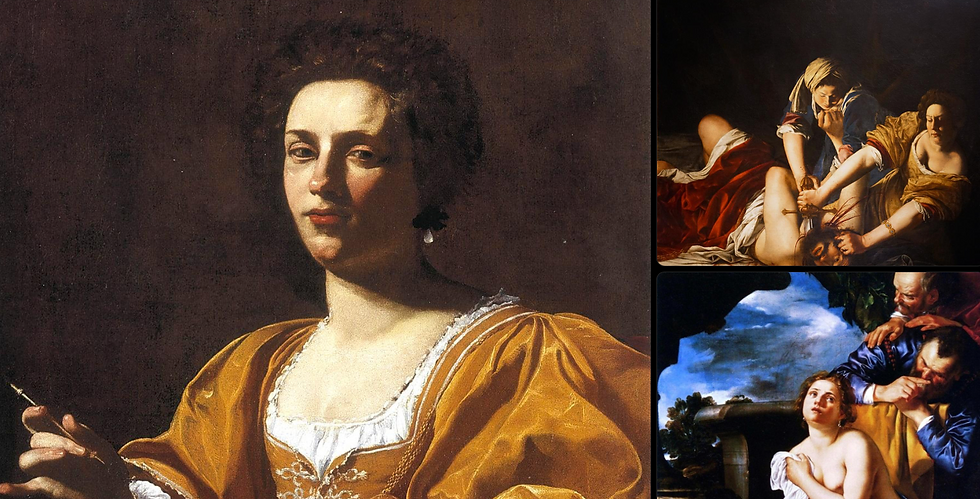
Some painters followed his style so closely that they became known as Caravaggisti, or followers of Caravaggio. Among the most important artists influenced by him was Artemisia Gentileschi, whose work demonstrates how his approach could be adapted into an entirely different artistic voice.
Caravaggio's influence was particularly strong in Spain, France, and the Netherlands. Artists who never met him could encounter his work through paintings that traveled between collections or through prints and copies. His visual language became part of the broader vocabulary of Baroque art.
His influence also extended far beyond painting. The dramatic lighting that made his compositions so distinctive has obvious parallels with modern photography and film. A filmmaker who places a character against a nearly black background and illuminates only the face is using a visual principle that Caravaggio helped establish as one of the great tools of dramatic representation.
The fact that his paintings can look surprisingly contemporary is therefore not accidental. Modern visual culture inherited much from the Baroque tradition, even when viewers do not realize it.
The Final Journey
By 1610, Caravaggio was still hoping to obtain a pardon that would allow him to return safely to Rome. He had received indications that his efforts might succeed, and he traveled northward from Naples.
He never reached Rome.
While traveling near the coast of Tuscany, Caravaggio became seriously ill and died at the age of thirty-eight. The precise circumstances of his death have been debated, and over the centuries a number of theories have been proposed concerning his illness. What is certain is that he died far from the city where he had established his reputation and without receiving the full pardon he had spent his final years seeking.
His death ended a life that had been remarkably short but extraordinarily productive. In less than four decades, Caravaggio had transformed religious painting and established a visual vocabulary that would influence European art for generations.
The Complicated Man Behind the Paintings
Caravaggio presents a challenge to anyone interested in the relationship between an artist's life and his work. It is easy to turn him into a romantic legend: the rebellious genius who refused to follow society's rules, lived dangerously, and poured his troubled personality into his paintings. That version of the story is entertaining, but it can also be misleading.
Caravaggio's violence was real. The man he killed was real. The people affected by his behavior were real. There is no reason to excuse his actions simply because he was an extraordinary artist.
At the same time, there is no need to pretend that his personal failures cancel out his artistic achievements. The history of art is filled with complicated individuals, and appreciating a work of art does not require us to approve of the person who created it.
Caravaggio's achievement is significant on its own terms. He changed the way painters represented human beings. He changed the emotional intensity of religious art. He demonstrated that ordinary people could serve as convincing models for sacred figures. He made light and darkness central elements of storytelling rather than merely technical devices. Most importantly, he made paintings feel immediate.
Why Caravaggio Still Matters
One of the remarkable things about looking at a Caravaggio painting today is how little explanation is sometimes necessary. A viewer may know nothing about Baroque art, the Counter-Reformation, or seventeenth-century Rome and still understand that something dramatic is happening.
The reason is that Caravaggio understood the basic language of human attention. We look where the light tells us to look. We respond to faces. We notice movement. We understand fear, surprise, grief, determination, and physical struggle. Caravaggio used these elements with extraordinary precision.
His religious paintings are therefore more than illustrations of biblical stories. They are carefully constructed experiences for the viewer. We are placed close to the action, surrounded by darkness, and given just enough information to understand what is happening. The result is a kind of visual theater in which the canvas becomes a stage.
This is why his work continues to feel surprisingly modern. The same principles can be found in photography, film, advertising, and contemporary visual storytelling. A dramatic face emerging from darkness is not an invention of modern cinema. Caravaggio had already understood its power centuries earlier.
His legacy is therefore larger than the Baroque period itself. Artists continued to borrow his lighting and naturalism long after his death, and modern audiences continue to respond to the directness of his paintings. He managed to make subjects that had been painted for centuries feel immediate again.
Perhaps that is the best way to understand Caravaggio. He did not simply paint religious stories; he made viewers feel as though they had arrived in the middle of them. He did not merely use darkness as a background; he turned darkness into a dramatic force. And he did not make his saints and biblical figures impossibly perfect. He gave them human bodies, human faces, human fears, and human reactions.
Caravaggio's personal life remains fascinating because it was so turbulent, but the real reason we continue to remember him is found on the canvas. The fights, arrests, escapes, and scandals make for an extraordinary biography, but they are not what changed the history of art.
The paintings did.
More than four centuries later, a figure still emerges from the darkness in The Calling of Saint Matthew. Judith still struggles with Holofernes. The apostles still grieve beside the dead Virgin. David still holds the head of Goliath and looks at it with an expression that seems almost painfully human.
Caravaggio understood that light could reveal more than a face.
It could reveal a story.
And once he showed European painters how powerful that could be, they never quite looked at light—and at the people standing inside it—the same way again.
Comments