
Artemisia Gentileschi: A Woman Who Refused to Disappear
For much of history of Western art, women appeared in paintings far more often than they appeared among the people who created them. They were painted as saints, queens, goddesses, mothers, lovers, and muses, but the institutions that trained and promoted professional artists were overwhelmingly controlled by men. A woman who wanted to become a serious painter faced obstacles that had little to do with talent. She needed access to training, materials, patrons, and opportunities to exhibit and sell her work, all of which were difficult to obtain in a society that generally expected women to remain within the home.
Against this background, the career of Artemisia Gentileschi is extraordinary. Born in Rome in 1593, she became one of the most accomplished painters of the Italian Baroque and eventually worked for important patrons in Florence, Rome, Naples, and England. Her paintings are dramatic, technically sophisticated, and often filled with powerful biblical and mythological women. Yet for centuries, her reputation was overshadowed by the story of her personal life, particularly the sexual assault she experienced as a young woman and the public trial that followed.
Today, Artemisia is recognized as a major artist in her own right. Her story is not simply one of tragedy and survival, however. It is the story of a highly ambitious painter who developed a successful international career in a world that gave women very few opportunities to do so. Her paintings reveal an artist who understood drama, color, movement, and human emotion, and who was capable of taking familiar subjects from the Bible and mythology and giving them an intensity that remains striking centuries later.
Growing Up in an Artist's Household
Artemisia was born into a family that gave her one advantage that many women of her time did not have: she grew up surrounded by art.
Her father, Orazio Gentileschi, was a successful painter in Rome. He worked in the dramatic style that had become fashionable in the early seventeenth century and was influenced by the revolutionary painter Caravaggio. Orazio's paintings combined strong contrasts of light and shadow with naturalistic figures and dramatic compositions. His professional connections and knowledge of the Roman art world gave Artemisia access to artistic training from an early age.
Her mother died when Artemisia was still young, and by her teenage years it had become clear that she possessed considerable artistic ability. Orazio trained her in his workshop, where she learned the practical skills required of a professional painter. She studied drawing, painting, the preparation of pigments, and the handling of canvases. She also learned by observing the work of other artists and by studying the paintings that surrounded her in Rome.
This may sound ordinary to us, but it was anything but ordinary for a young woman in the early seventeenth century. Women were generally not admitted to the major artistic academies in the same way men were, and they were often denied access to the study of the nude human figure, which was considered essential to advanced training. Artemisia therefore had to develop her abilities under circumstances that were very different from those of her male contemporaries.
By the time she was in her late teens, she was already producing sophisticated paintings.
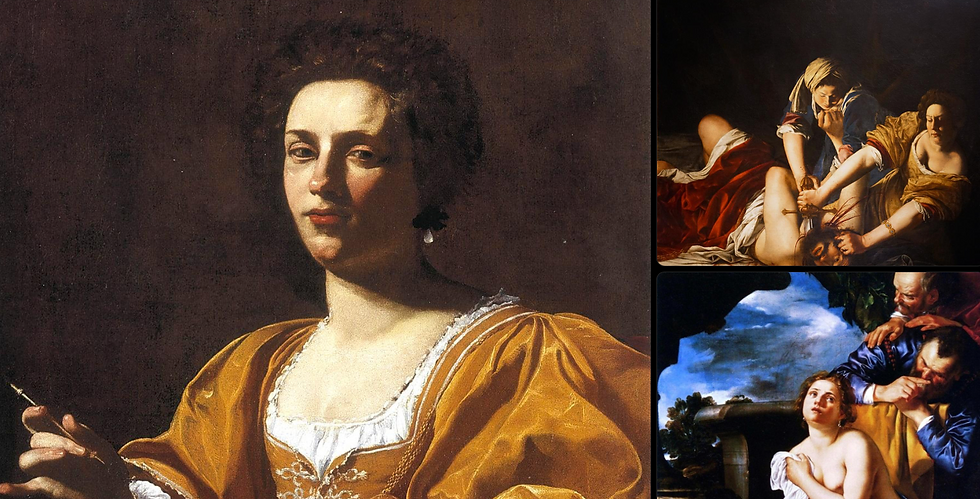
One of her earliest surviving works is Susanna and the Elders, painted in 1610. The subject comes from the biblical story of Susanna, a woman who is secretly watched by two older men while she bathes. When she refuses their advances, they falsely accuse her of adultery.
The subject had been painted many times by male artists, but Artemisia's version is striking for the way it presents Susanna. Rather than appearing serene or passive, Susanna looks deeply distressed. Her body twists away from the men, and her arms rise defensively as she attempts to escape their attention. The painting demonstrates that Artemisia was already capable of conveying psychological tension and physical movement at a remarkably young age.
It also introduces something that would become important throughout her career: women in Artemisia's paintings often appear to have strong emotional and physical reactions to the situations in which they find themselves.
The Trial
Artemisia's life changed dramatically in 1611, when she was seventeen.
She was sexually assaulted by the painter Agostino Tassi, a colleague of her father's. Orazio brought the matter to the authorities, and the resulting trial lasted several months. The proceedings were public, invasive, and humiliating. Artemisia was questioned repeatedly about the assault, and the legal system subjected her testimony to scrutiny that would be difficult for anyone to endure.
The trial is one of the most extensively documented episodes in her life, largely because court records have survived. They provide an unusually detailed glimpse into the experiences of a young woman living in seventeenth-century Rome.
It is important, however, to resist allowing the trial to become the entire story of Artemisia Gentileschi.
For centuries, historians and writers often treated the assault as the central fact of her life. Her paintings were sometimes interpreted almost entirely through the lens of the trauma she experienced. While the experience undoubtedly affected her, Artemisia was more than a victim of violence. She was a professional artist who went on to build a career that was remarkable by the standards of her time.
The trial itself ended without the kind of justice we might expect today. Tassi was convicted, but the punishment was never fully carried out. Artemisia, meanwhile, had to continue living in a society in which her reputation had been publicly exposed.
Yet she did not disappear from the artistic world.
Instead, she continued painting.
Judith and Holofernes
One of Artemisia's most famous paintings is Judith Slaying Holofernes, which depicts a dramatic episode from the biblical Book of Judith.
The story tells of Judith, a Jewish widow who enters the camp of the Assyrian general Holofernes. She gains his trust, waits until he is vulnerable, and then kills him by cutting off his head. Judith saves her people through courage and determination.
The subject was popular during the Baroque period because it offered artists an opportunity to depict violence, suspense, and dramatic emotion. Caravaggio had famously painted the same subject, and his version had a major influence on Artemisia.
But Artemisia's interpretation is particularly powerful.
Judith is not presented as a delicate figure who hesitantly carries out the act. She is physically engaged in the struggle. Her companion, Abra, helps restrain Holofernes while Judith grips his head and drives the sword downward. The figures occupy nearly the entire canvas, leaving little room for escape. Blood moves across the white sheets, while intense contrasts of light and darkness heighten the drama.
The physical strength of the women is impossible to overlook.
For generations, viewers have naturally connected this painting with the assault Artemisia suffered as a young woman. Some have suggested that Holofernes represents Tassi and that the painting should therefore be understood as a form of revenge. That interpretation is tempting, particularly because of the painting's violence, but it is also too simple.
Artemisia was working within a long tradition of biblical and mythological painting. Judith had already been a popular subject before her. The painting can certainly be understood in relation to Artemisia's experiences, but it also demonstrates her sophisticated understanding of Baroque composition, her knowledge of Caravaggio, and her ability to create a compelling narrative image.
The painting is not important merely because of what happened to its creator.
It is important because it is an extraordinary painting.
Florence and a New Life
After the trial, Artemisia married the Florentine painter Pierantonio di Vincenzo Stiattesi and moved to Florence.
This was a turning point in her career.
Florence was home to one of the most important artistic cultures in Europe, and Artemisia quickly established connections with wealthy and influential patrons. She received commissions and became associated with the court of Cosimo II de' Medici, the Grand Duke of Tuscany.
Her success was remarkable enough that she became the first woman known to have been admitted to the Accademia delle Arti del Disegno, one of Europe's important artistic academies.
Membership gave her a level of professional recognition that was extremely unusual for a woman at the time.
Artemisia was no longer simply the daughter of a painter.
She was an artist with her own reputation.
Her letters from this period also reveal a woman who understood the practical realities of the art business. She negotiated prices, sought commissions, discussed payments, and cultivated relationships with powerful patrons. She was not simply waiting for opportunities to come to her.
She actively pursued them.
A Professional Woman in a Man's World
This aspect of Artemisia's career deserves particular attention because it challenges the idea that women artists of the past were merely exceptions who somehow managed to paint despite their circumstances.
Artemisia was a professional.
She expected to be paid for her work. She negotiated with patrons. She traveled. She maintained a workshop. She raised a family while continuing her career. She moved between cities when opportunities required it.
Her success demonstrates that women could participate in the professional art world when circumstances allowed them access to training and patrons.
It also reveals just how difficult the system could be.
Artemisia frequently had to establish her credibility in ways male painters did not. Her gender was part of the conversation surrounding her work, and patrons sometimes approached her specifically because she was a woman. At the same time, she had to prove that her work deserved serious consideration on artistic grounds.
She managed to do both.
Women as Heroines
Artemisia returned repeatedly to stories involving powerful women.
Judith was one. Another was Jael, a biblical heroine who kills the enemy commander Sisera. She also painted Esther, Cleopatra, Lucretia, and other women whose stories involved courage, danger, suffering, or moral decisions.
These subjects were not unusual in themselves. Renaissance and Baroque artists had been painting biblical and mythological heroines for centuries.
What distinguishes Artemisia's work is the intensity with which she presents them.
Her women frequently occupy the center of the composition. They are active rather than passive, and their physical presence is emphasized. Their expressions and gestures communicate determination, fear, grief, or concentration.
This does not mean that Artemisia simply painted “strong women” in the modern sense. Her subjects are complicated figures, and her paintings are rooted firmly in the religious and cultural world of seventeenth-century Europe. But she clearly understood how powerful a woman could appear when she was placed at the center of a dramatic story.
Artemisia's Relationship With Caravaggio
One of the most important artistic influences on Artemisia was Caravaggio, whose work transformed Italian painting around the beginning of the seventeenth century.
Caravaggio rejected many of the idealized figures favored by traditional painting and instead used ordinary-looking people as models for biblical characters. He placed them in dramatic settings and illuminated them with intense, directional light. His figures often appear to emerge from darkness.
Artemisia adopted many of these techniques.
Her paintings frequently use strong contrasts between light and shadow, a characteristic known as chiaroscuro. Her figures appear solid and physical, and her compositions often place the viewer close to the action.
But Artemisia was not simply copying Caravaggio.
She developed her own approach to color, composition, and storytelling. Her paintings often place particular emphasis on the experiences of women, and she became especially skilled at depicting the physical and psychological intensity of their situations.
Her work demonstrates how artistic influence works at its best. An artist studies someone who came before, absorbs what is useful, and then transforms it into something personal.
Naples and the Later Years
Artemisia eventually moved to Naples, where she spent much of the later part of her career.
Naples was an important artistic center, and Artemisia found opportunities there that allowed her to continue working as a professional painter. She ran a workshop and worked on commissions for churches and wealthy patrons.
She also became part of an international artistic network.
In the 1630s, Artemisia spent time in London at the court of King Charles I, where she joined her father, Orazio, who had been invited to England to work for the royal court.
Her presence there is another indication of the level of professional recognition she had achieved. Artemisia had traveled from Rome to Florence, then to Naples, and eventually to one of the most powerful royal courts in Europe.
For a woman painter born in 1593, this was an extraordinary career.
The exact circumstances of her death are uncertain, but she is generally believed to have died sometime after 1654, probably in Naples. By that point, she had spent decades working as a professional artist.
What Happened to Her Reputation?
The strange thing about Artemisia's story is that she was relatively successful during her own lifetime but became much less prominent after her death.
Her paintings were sometimes attributed to male artists, including her father. This was not uncommon for women artists, whose work could be overlooked, misattributed, or absorbed into the reputations of male colleagues and relatives.
For centuries, Artemisia was not given the attention that her accomplishments deserved.
Her reputation began to change significantly in the twentieth century as scholars became more interested in women artists and began reassessing works that had previously been overlooked. Paintings that had been attributed to other artists were reconsidered, archival records were examined, and Artemisia's body of work began to emerge more clearly.
Today, she is recognized as one of the most important painters of the Italian Baroque.
Her paintings hang in major museums around the world, and her name is now discussed alongside the male artists of her generation rather than as a historical curiosity.
Looking Beyond the Story
There is a temptation when discussing Artemisia Gentileschi to focus entirely on the dramatic parts of her biography. The assault, the trial, the violence of Judith Slaying Holofernes, the obstacles she faced as a woman—all of these things make for a compelling story.
But if we focus only on those elements, we risk making the same mistake that earlier generations of historians made.
Artemisia deserves to be remembered not simply because she survived something terrible.
She deserves to be remembered because she was an exceptional painter.
Look carefully at her work and the technical skill becomes impossible to ignore. Her figures have weight and presence. Her compositions are carefully controlled. Her use of light creates drama without sacrificing clarity. Her colors can be extraordinarily rich, and her ability to tell a story through gesture and expression is remarkable.
She understood how to make a viewer feel as though an event were happening in front of them.
That is not simply the result of her biography.
It is the result of her talent.
Why Artemisia Matters
Artemisia Gentileschi's career forces us to reconsider some of the assumptions we make about the history of art.
For a long time, art history was often presented as a story of great male artists: Leonardo, Michelangelo, Caravaggio, Rembrandt, Rubens, and countless others. Women certainly appeared in the story, but usually as subjects, patrons, or muses rather than creators.
Artemisia complicates that narrative.
She demonstrates that women were not absent from the history of art because they lacked talent or ambition. They were often absent because the systems that produced, taught, collected, and recorded art made it much more difficult for them to succeed.
When a woman did break through those barriers, her accomplishments could easily be forgotten.
Artemisia was not forgotten entirely, but she came close to being reduced to a footnote.
Her rediscovery has therefore been important not only because it restores one remarkable painter to her rightful place, but because it reminds us how incomplete our understanding of art history can become when we only tell the stories that were preserved most successfully.
The Woman Behind the Paintings
Perhaps the most interesting thing about Artemisia Gentileschi is that her life does not fit neatly into a single story.
She was a daughter, a student, a survivor, a wife, a mother, a businesswoman, and a professional artist. She worked for wealthy families, religious institutions, aristocrats, and royalty. She traveled across Europe and maintained a career for decades.
She lived in a period when women were expected to occupy a very different place in society, yet she managed to establish herself as a professional painter in some of the most competitive artistic centers in Europe.
Her paintings remain powerful because they bring together two things that are often separated when we talk about art: technical achievement and human experience.
When we stand in front of Judith Slaying Holofernes, we can think about Artemisia's life, her struggles, and the extraordinary circumstances surrounding the painting. But we can also simply look at the painting itself: the composition, the movement, the color, the expressions, the dramatic lighting, and the sheer physical force of the scene.
The longer we look, the more the painting becomes more than a story about Artemisia.
It becomes the work of an artist who understood how to hold a viewer's attention.
And perhaps that is the most important thing to remember about her.
Artemisia Gentileschi did not merely survive the difficult world into which she was born. She built a life and a career within it, established herself among the artists of her generation, and left behind paintings that have endured for centuries.
Her story reminds us that the history of art is not only a history of styles and movements. It is also a history of people who struggled to make something lasting, often under circumstances that we can scarcely imagine.
Artemisia's paintings survived.
So did her name.
And after centuries in which her work was too often overlooked, she finally occupies the place she earned: not simply as a remarkable woman who painted in the Baroque period, but as one of the great painters of her age.
Comments